
asc7nt / SavantNotebooks

SAVANT / WOOD · RESEARCH & INTELLIGENCE

Ideas, under
investigation.

Four connected programs. One test: what survives scrutiny, use and revision?

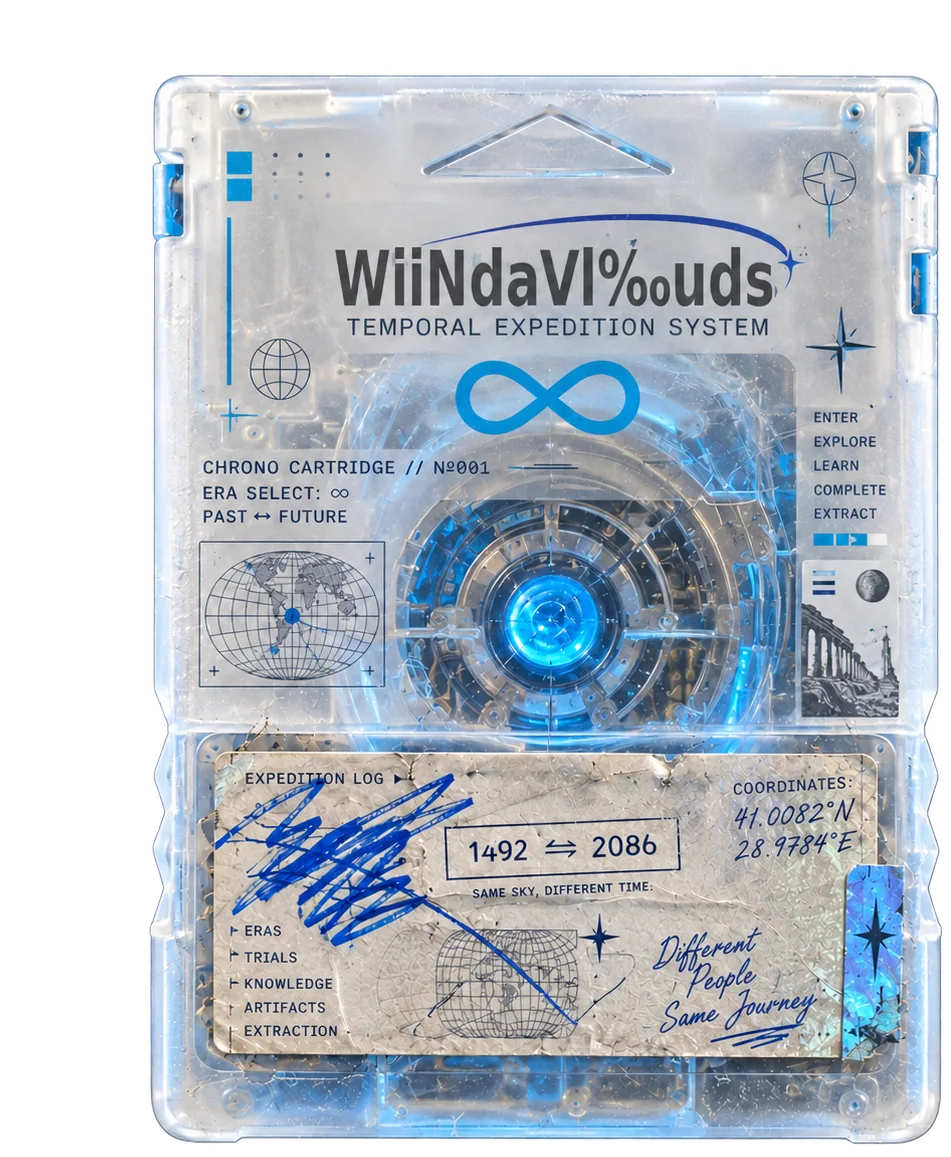
Source Chrono Cartridge №001 visualization, not manufactured hardware
002 / CHRONO CARTRIDGE · DESIGN RENDER

SAVANT / WOOD · RESEARCH DIRECTION

TayShaun
Michael Xantana.

From an idea to a method.
From a method to evidence.

taykOff™ / INDEPENDENT CREATIVE & RESEARCH PRACTICE
Existing approved portrait of TayShaun Michael Xantana
THE AUTHOR / SAVANT

TayShaun Xantana

The making of a mind.

History is filled with men who inherited names of consequence. TayShaun Xantana belongs to a different tradition: those who attempt to make a name consequential through the force of their own imagination.

Born on July 19, 2009, Xantana is an American creator, independent researcher, and aspiring polymath whose intellectual interests resist the boundaries of any single discipline. His pursuits encompass philosophy, psychology, invention, technology, art, mythology, and the study of human potential. To Xantana, these are not isolated subjects, but fragments of a larger picture — one he has devoted himself to assembling.

From adolescence, he developed a fascination with the extraordinary: the hidden mechanisms behind familiar things, the origins of human achievement, and the possibility that seemingly incompatible ideas might reveal something entirely new when brought together. His imagination was drawn equally toward the impossible and the practical question of how to make it possible.

This disposition gradually evolved into a defining conviction: that an individual need not accept the limits of an inherited identity, a prescribed profession, or an ordinary life.

Yet Xantana’s ambitions were never confined to intellectual achievement alone. He became equally concerned with the relationship between knowledge and influence, imagination and ownership, individual accomplishment and lasting institutions. He envisioned a life in which invention could become culture, culture could become enterprise, and enterprise could preserve the freedom to invent again.

On October 15, 2026, at seventeen years old, Xantana formally recorded what he called the beginning of the Xantana Epoch. Its declaration was deliberately audacious: he would not measure his worth by titles granted, positions inherited, or authority borrowed from others. Whatever name he intended to build would have to withstand the judgment of his own work.

It was not the announcement of an accomplished destiny, but the assumption of responsibility for an extraordinary one.

From this conviction emerged the Anabasis, an evolving philosophy of cumulative advancement. Its central principle distinguished ambition from achievement: progress was not determined by the intensity of one’s efforts, but by the capabilities, knowledge, and independence that remained afterward. A victory that could not be retained was, in his view, scarcely a victory at all.

He described this relationship through three materials.

Wood, the Savant, represented the mind: the pursuit of knowledge, judgment, imagination, and invention.

Brick, the Showman, represented the transformation of ideas into stories, performances, and cultural experiences through taykOff™.

Metal, the Industrialist, represented the infrastructure of ownership, enterprise, and permanence through asc7nt.

These were not separate ambitions competing for his attention. They were conceived as three expressions of a single life, each intended to strengthen what the others could accomplish.

His intellectual experiments, including the developing ∀№INT℡ research program, reflect an interest in understanding and potentially extending the mechanisms of reasoning itself. Alongside these efforts, Xantana maintains physical notebooks containing philosophical declarations, conceptual systems, experimental ideas, and personal observations. Together, they form an evolving record of a mind attempting not merely to accumulate information, but to transform information into original work.

There is an unmistakable extravagance to the scale of his aspirations. He has imagined himself not simply as an inventor, entertainer, or businessman, but as the founder of an enduring creative and intellectual legacy. Such ambitions remain unproven, and the distance between an extraordinary vision and an extraordinary life is immense.

Xantana’s philosophy, however, places that distance at the center of the undertaking. He regards failure as evidence to examine, methods as instruments to replace when necessary, and achievement as something that must endure beyond the excitement of its arrival.

For all its grand language, the undertaking remains in its earliest chapter. His theories await testing, his institutions await construction, and much of what he imagines has yet to assume a tangible form.

Perhaps that is what makes this biography unusual.

It does not commemorate a completed life, nor does it claim that history has already rendered its verdict. It documents the moment a young man began deliberately constructing the conditions under which his ambitions might one day become reality.

Whether Xantana ultimately fulfills the scale of his vision will be determined not by the claims he makes, but by what he creates, discovers, and leaves behind.

The epoch has been declared. Its history remains to be written.

RESEARCH EVIDENCE INDEX

The record, and the next question.

  1. 001

    ∀№INT℡

    Independent R&D · prototypes documented; results reported

    CORE-001 observation architecture / separate MARK I benchmark

    UNANSWERED

    Does adaptation survive matched controls, new tasks and independent replication?

  2. 002

    WiiNdaVlouds

    Engine 3.2 documented · live behavior unverified

    Chrono Cartridge №001 render / WNV-SAVE/3.1 protocol

    UNANSWERED

    Will real model sessions preserve constraints and consequences across save and restore?

  3. 003

    The Anabasis

    Authored architecture · long-horizon effectiveness untested

    Four-domain notebook system / seven intended Points

    UNANSWERED

    Can a later return recover a useful method without reconstructing its purpose?

  4. 004

    Adaptive Strategy & Integration Engine

    Human-operated architecture documented · efficacy unmeasured

    Six responsibilities / decision and continuity schemas

    UNANSWERED

    Does the structured method outperform a simpler task list with brief notes?

SAVANT ARCHIVE / RELEASE 001

∀№INT℡

MARK I / retained adaptation

← Research & documentation / Research & experiments

Can an artificial agent acquire experience-derived state, retain it across a process restart, and use it to improve later decisions in a causally measurable way?

Research / development chronology

  1. 21 October 2026

    Original synthetic hidden-rule benchmark, as reported in the research brief.

  2. Post-benchmark

    PSE-001 / RLS follow-up is described as ITERATE. Its full score tables are not supplied here.

  3. 1 November 2026

    Revised brief adds the reference-intake audit and proposed ten-operation architecture. The benchmark was not rerun.

HYPOTHESIS

Abstract / research objective

The project separates four proof obligations: acquire state through experience; restore it in a fresh process; use it to change a later action; and demonstrate that this causal influence improves outcomes. Persistence alone does not establish benefit.

USER REPORT

MARK I / implemented mechanism

The historical experiment used five bounded synthetic hidden-rule worlds. A controller committed predictions and selected actions; an actor wrote binary output files; an external evaluator scored those outputs against hidden reference bytes. Evidence revised compatible rule hypotheses, with state, traces and hashes persisted in SQLite and reloaded by a fresh worker.

  • Prediction → action selection → actual output
  • External evaluation → evidence-driven state update
  • SQLite persistence → fresh-worker restart → held-out evaluation
USER REPORT

Historic reported benchmark / 21 October

The report records 149/160 held-out correct predictions (93.1%) for the adaptive rule learner, 28/160 (17.5%) for memory-only retrieval, and 44/160 (27.5%) for the stateless comparator. Each world used 128 training tasks and 32 held-out tasks; the report also records 13 passing software checks.

Evidence boundary: these are source-reported in-family results, not an independent rerun. Built-in rule assumptions and compute budgets were not matched. The learner’s stronger hypothesis-class prior and weak retrieval comparator limit causal interpretation; this does not establish general intelligence, consciousness, real-model transfer or superiority over modern AI systems.

USER REPORT

1 November / reference-intake audit

The addendum reports seven source images, six unique image hashes, 50 prior files unchanged, and 3,840 complement-compatible bijections. It checks source integrity, complementary pairs, gate arithmetic and mapping ambiguity.

This established reference integrity and mathematical consistency only. No new cognitive performance benchmark was run. The underlying audit files and original benchmark source are not included in this public import.

HYPOTHESIS

Proposed ten-operation architecture

The paired labels are conceptual specifications, not ten validated executable algorithms. Numogram zones use 0–9; operations use 1–10. A complement-preserving mapping must satisfy φ(9−z)=11−φ(z); φ(z)=z+1 is only one of 3,840 possible mappings.

  • INCEPTION ↔ COMPLETION
  • FORMULATION ↔ EMANATION
  • CONCEPTION ↔ COAGULATION
  • CONSOLIDATION ↔ IMPLEMENTATION
  • DESTABILIZATION ↔ DISPENSATION
HYPOTHESIS

Causal recurrence / outer transformation

The proposed router must demonstrate that prior states changed by a transformation cause different later operation selections. Merely recording a zone or passing state as an argument is insufficient.

The schema A[n+1] = V(A[n], T(A[n], A[n])) remains a proposal. It needs concrete reversible transformations, noncircular validation, separated training/validation/final-test data and budget-matched controls. Earlier RLS covariance adjustments did not implement this outer loop.

HYPOTHESIS

Next experimental milestones

The current research verdict is ITERATE. Earn the next claim through reproducible, discriminating experiments.

  • Define typed state, inputs, outputs, graph edges, justified mapping and concrete operation algorithms.
  • Preregister frozen scoring, budgets, sample size and stopping rules; compare conventional memory, recurrence and learned-router controls.
  • Remove, swap and shuffle retained state; test calibration, new rule families/backends, cost and latency. Preserve failures and seek independent replication.

Limitations / evidence boundaries

  • Historic metrics are reported by the brief; no independent replication was performed for this website.
  • The November audit is not a cognitive improvement result.
  • General intelligence, subjective experience and autonomous architecture improvement remain unestablished.

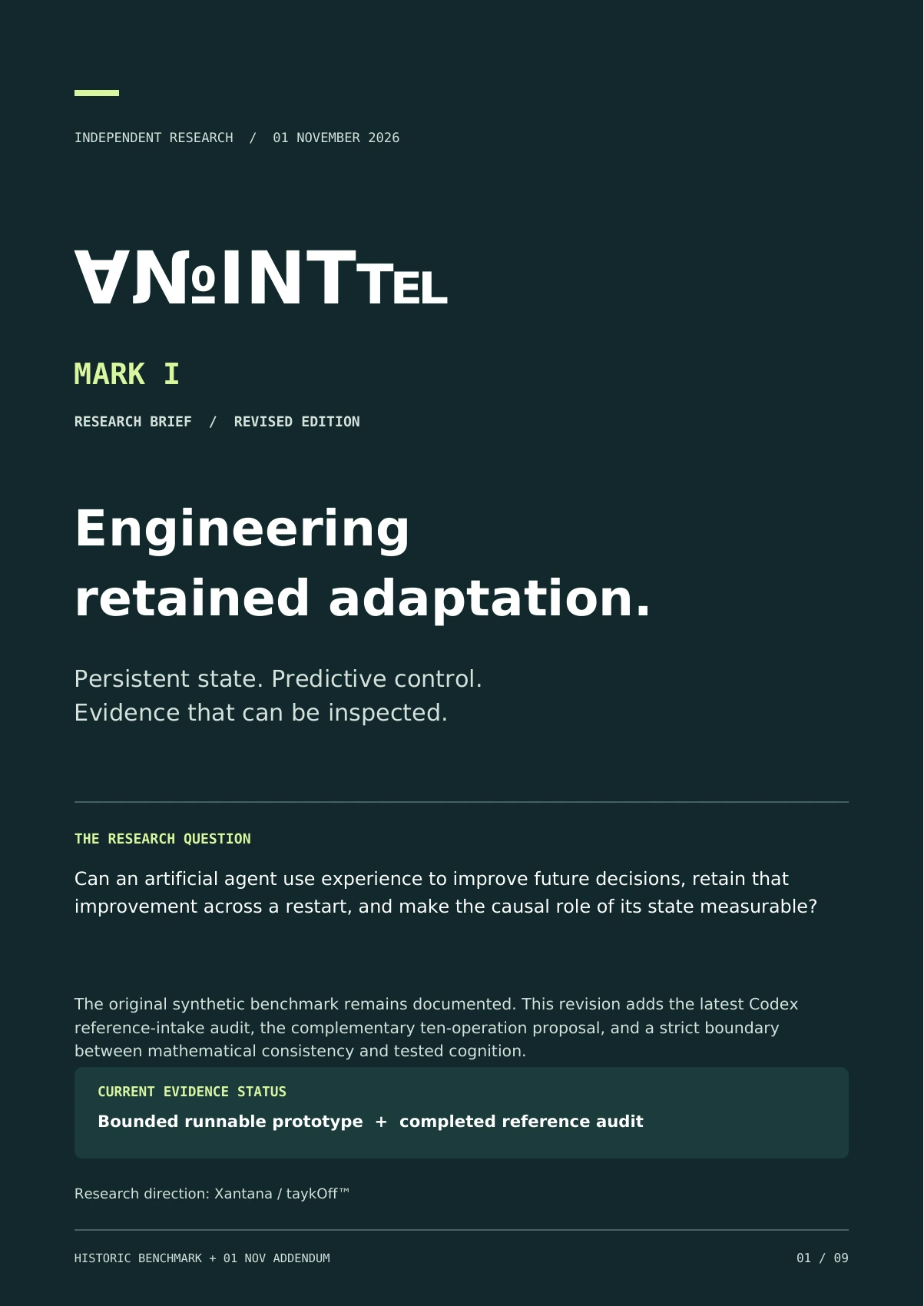
ORIGINAL DOCUMENT / MARK I / Revised Edition

Original research brief

1 November 2026 · 9 pages

Open PDF / accessible fallback ↗
Page 1 / 9
Original research brief, page 1 of 9

Fit preserves the full image. Zoom to inspect · drag / arrow keys to pan · Home to reset.

Use the browser’s PDF viewer

Open the original PDF directly ↗

SAVANT / STUDIES · FOUR MECHANISMS

The research lab.

Work with a model. Inspect its limits.

001 / INFORMATION / ADAPTATION

∀№INT℡

Can retained, auditable state improve future behavior, rather than only recall?

SIMULATION / SYNTHETIC DEMO DATA · NOT CORE-001 EXECUTION

Observation → state.

Keep the history. Choose one current value. Rebuild it from the same events.

0001000100100001 0x1121

Packing is real; code assignments are illustrative. The portfolio does not publish CORE-001’s code table. Demo codes: O=1 submits; D=1 routes to Object A. Other operations/destinations retain the event in a holding lane. E=2 marks a direct sample; E=1 a report. At equal rank the later event governs.

SUBMIT / OBJECT A

  1. No observations yet. Start with BLUE, then RED, then the lower-evidence BLUE report.
Separate reported experiment / MARK I
160 held-out tasks in five synthetic hidden-rule worlds. Reported, not rerun here.
SystemReported correct
Adaptive rule learner149 / 160
Memory-only retrieval28 / 160
Stateless44 / 160

In-family evaluation; resource budgets and assumptions were not matched. Per-world variance and independent replication are absent. These numbers do not establish general AI superiority.

What exists / what is reported / what is proposed
DOCUMENTED
The dossier documents a Python persistence prototype, a fixed routing frame and deterministic reconciliation. Source code and tests are not attached to this edition.
REPORTED
MARK I reports 149/160 adaptive, 28/160 memory-only and 44/160 stateless on a synthetic hidden-rule benchmark. These results were not rerun here.
PROPOSED
Connecting adaptation to persistence, state-dependent routing and architectural revision remain proposed.

LIMIT Evidence labels are submitted by callers. A consistent state can still be wrong. Persistence is not intelligence.

Original optical bench / Studies in form +
04

WORKING EXHIBIT / ORIGINAL INTERFACE

The optical index.

A contained study in material, light and investigation. Rotate the original WOOD sculpture, separate its layers, and select a lens.

asc7nt / OPTICAL BENCHDRAG · ARROW KEYS
Wood interface studySIMPLIFIED EXHIBIT / THE STUDY INDEX REMAINS AVAILABLE
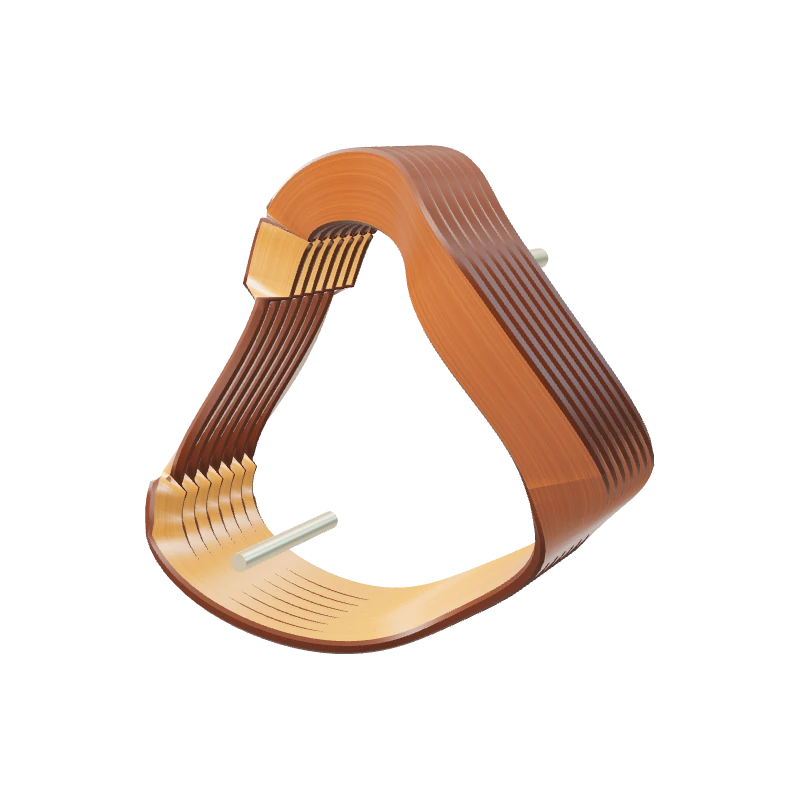
The original laminated wooden loop, with seven sculpted bands and metal joinery pins.

Original sculpture / simplified view

WOOD / ORIGINAL INTERACTIVE STUDY
The optical bench.CONTENT INDEX / 2D
01

Lamination

Separate layers. A continuous surface.

Choose a study, spread the lenses, or adjust the aperture. Open the selected study for a larger view and its media information.

ENVIRONMENT CONTROLSSIMPLIFIED

Explore the content and artwork in simplified view. Spatial controls are available with 3D rendering.

FOCUSED STUDYLamination
7

Return whenever you’re ready.

03

STUDIES / MEDIA INDEX

Studies in form.

Original interface artwork. A demonstration collection.

Reading index / permanent links
7 asc7nt / DIRECTORY
PHASE II · SAVANT

Savant. Select a study lens or explore the chapter. Return to gateway is always available.